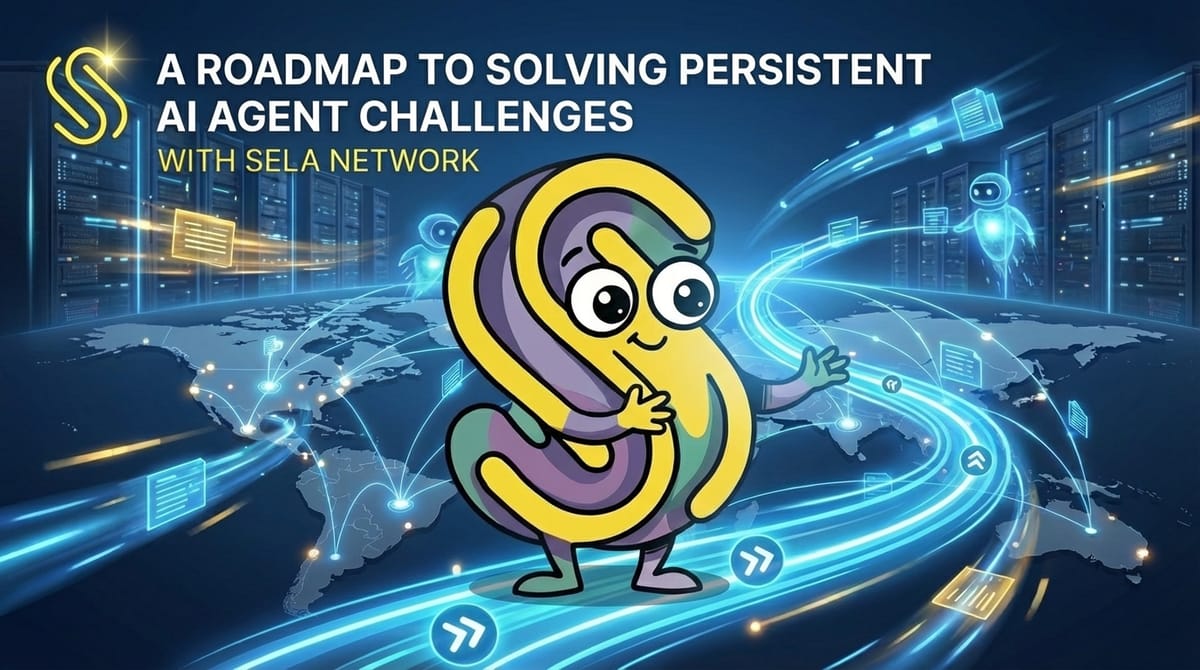
A Roadmap to Solving Persistent AI Agent Challenges with Sela Network
The Challenges AI Agents Face on Today’s Web Infrastructure
AI agents—autonomous software systems capable of planning and executing multi-step actions while making real-time decisions—are advancing faster than the web infrastructure they rely on. Over the past few years, agent-based systems have moved beyond demos and internal experiments and begun operating in real production environments across finance, healthcare, security operations, and customer support.
(Reference: Oyelabs, Common Challenges in Developing AI Agents )
The problem is that most existing web infrastructure is still built on human-centered assumptions. Humans click slowly, read carefully, wait for responses, and stop when something looks wrong. AI agents do none of these things. They operate at machine speed, interpret context dynamically, and chain actions continuously. As this gap widens, production systems begin to fail in subtle but persistent ways.
At first, the symptoms are easy to miss. Requests succeed, but outcomes do not fully materialize. Logs exist, yet system state does not align with expectations. Dashboards look healthy while user experience quietly degrades. Teams respond by adding retries, alerts, and more monitoring, but instead of clarity, the system becomes louder and harder to reason about.
In practice, these failures tend to cluster around four areas: security, scalability, identity and access control, and the structural limitations of the web itself.
Security Risks Introduced by Autonomy
Autonomy is what makes AI agents powerful. It is also what makes them dangerous when control systems are still designed for human-paced workflows.
Traditional applications, even complex ones, follow relatively predictable execution paths. AI agents do not. They construct actions on the fly, interpret external content, invoke tools dynamically, and often operate with broad permissions because narrowing access in advance is difficult. This significantly expands the attack surface.
Recent security research and incident reports show that many AI-related breaches do not resemble classic intrusions. Instead, attackers exploit prompt injection, unpatched dependencies, or weak runtime isolation to influence agent behavior. In many cases, the attacker does not need to “break in” at all. Manipulating the content an agent is likely to consume can be enough to redirect its actions.
(Reference: Trend Micro, State of AI Security Report 1H 2025 )
From the outside, everything appears normal. Requests are authenticated. Sessions are valid. Logs are written. The problem lies in intent. Human-centric approval loops and post-incident reviews simply cannot keep pace with machine-speed execution.
As a result, isolation mechanisms such as hardened sandboxes and runtime containment are becoming baseline requirements. Yet isolation alone is not sufficient. Without identity-aware audit trails that clearly answer who did what, when, and under which authority, post-incident analysis becomes guesswork rather than accountability.
(Reference: SecureOps, Agentic AI Security Recommendations)
Scalability and Integration in the Real World
Scaling AI agents is often described as an infrastructure challenge, but in reality it is also an operational and governance challenge.
Platforms like Kubernetes were designed around predictable services with relatively stable resource profiles. AI agents violate those assumptions. Their compute usage fluctuates based on input. Execution paths change depending on external content. Tool calls can fan out unexpectedly. Resource consumption becomes difficult to forecast.
Agents also tend to require ephemeral execution environments that combine strong isolation with fast startup times and deep integration into existing systems. Virtual machines provide strong boundaries but introduce overhead. Containers start quickly but require additional hardening. At scale—thousands of concurrent agent sessions—this becomes a nontrivial operational burden.
Integration adds another layer of complexity. Even sophisticated agents must interact with legacy systems: aging databases, brittle middleware, inconsistent schemas, and internal admin tools. When failures occur, they rarely happen loudly. Instead, systems slow down, costs rise, and reliability erodes gradually. Eventually, teams retreat by limiting agent scope—not because the idea failed, but because the risk-reward balance no longer makes sense.
(Reference: Bunnyshell, What Do You Use for AI Agent Infrastructure?)
Identity and Access Models That Don’t Fit Agents
To operate AI agents at scale, organizations inevitably confront identity problems.
Human users follow clear lifecycle processes: onboarding, role assignment, periodic review, and offboarding. AI agents do not. They are created dynamically, scaled up or down, delegated tasks, and decommissioned—often within short time spans.
Many teams attempt to force agents into human IAM models or treat them as generic service accounts. The result is predictable: shared credentials, over-provisioned permissions, and access that persists long after the agent instance has disappeared. Traceability degrades, and incident response slows.
This leads to what is increasingly referred to as non-human identity sprawl. Zero Trust principles—fine-grained access control, microsegmentation, and minimal blast radius—make sense in theory, but they require agent identities that can be issued, scoped, and revoked programmatically. Without that foundation, Zero Trust remains aspirational rather than enforceable.
(Reference: ALM Intelligence, Securing AI Agents)
Structural Limits of the Web Itself
Beneath security, scalability, and identity lies a deeper constraint: the web was never designed for autonomous actors.
HTTP is stateless. Authentication is often centralized. Trust is assumed rather than proven. Humans compensate naturally by remembering context, re-authenticating when needed, and stopping when something feels wrong. AI agents do not.
Agents require persistent context, safe coordination across instances, and verifiable execution results. Most teams attempt to compensate with middleware, retries, wrappers, and monitoring layers. Over time, these layers accumulate, and the system becomes increasingly fragile.
At that point, adding another tool rarely helps. The problem is architectural, not incremental.
How Sela Network Approaches the Problem
Sela Network does not start from the question of how to automate browsers faster. It starts by asking why agents fail once they leave controlled environments.
Again and again, the answer points back to centralization, fragile trust assumptions, and inadequate identity models.
Instead of centralized browser farms, Sela operates a distributed network of real browser nodes across more than 150 countries. These nodes execute live sessions in real environments. When one path is blocked or disrupted, others remain available. There is no single choke point and no single provider whose failure can halt the system.
This approach does not make agents smarter. It makes them operable.
A Three-Layer Architectural Perspective
Sela’s design can be understood through three cooperating layers.
The first is a distributed browser execution layer. Real browsers handle real sessions, and redundancy emerges naturally through distribution rather than centralized orchestration.
The second is a semantic interpretation layer. Instead of relying on brittle selectors, interfaces are interpreted at a meaning level, closer to how humans perceive UI elements. Outputs are normalized into structured representations, reducing maintenance overhead when websites change and simplifying downstream integration.
The third is a cryptographic verification layer. Using approaches such as zk-TLS, execution results and data provenance become verifiable. In regulated environments—finance, compliance, legal—this matters. Logs alone are not enough. Evidence must be provable.
(Reference: Help Net Security, Digital.ai Brings Expert-Level Cryptography to Developer Teams)
Identity Designed for Agents
One of Sela’s key design choices is treating agent identity as a foundational layer.
Each agent instance can be issued a unique, cryptographically verifiable identity inspired by decentralized identity principles. Credentials can be scoped narrowly, delegated when needed, and revoked automatically as part of the agent lifecycle. Actions are tied directly to identity, not shared accounts or IP addresses.
This reduces credential sprawl, improves traceability, and makes least-privilege enforcement practical rather than theoretical. Federated trust models also become possible, which is critical in partner ecosystems and cross-organization workflows.
(Reference: Ping Identity, Decentralized Identity Management Fundamentals)
What Verifiable Execution Changes
One of the most persistent pain points in agent systems is ambiguity: did something really happen, and can we prove it?
When execution results are verifiable, teams spend less time building defensive scaffolding around agents. Security shifts from reactive investigation to proactive control. Operations become less brittle. Trust becomes something that can be checked, not assumed.
Sela’s focus is not on enabling more automation for its own sake, but on making automation auditable, attributable, and governable.
Closing Thoughts
AI agents are not waiting for infrastructure to catch up. They are already acting in production systems. The real question is not whether organizations will use agents, but whether they can do so at scale without letting risk grow faster than capability.
That answer depends less on models and more on the systems those models interact with. Execution environments, identity frameworks, and verification mechanisms matter.
Sela Network approaches this as an infrastructure problem—one where autonomy is supported by trust, not undermined by it.