Everything You Need to Know About Agentic AI Architecture: From Experimental Systems to Production-Ready Infrastructure by 2026
Technical Evolution of Agentic AI Architecture and Multi-Agent Orchestration
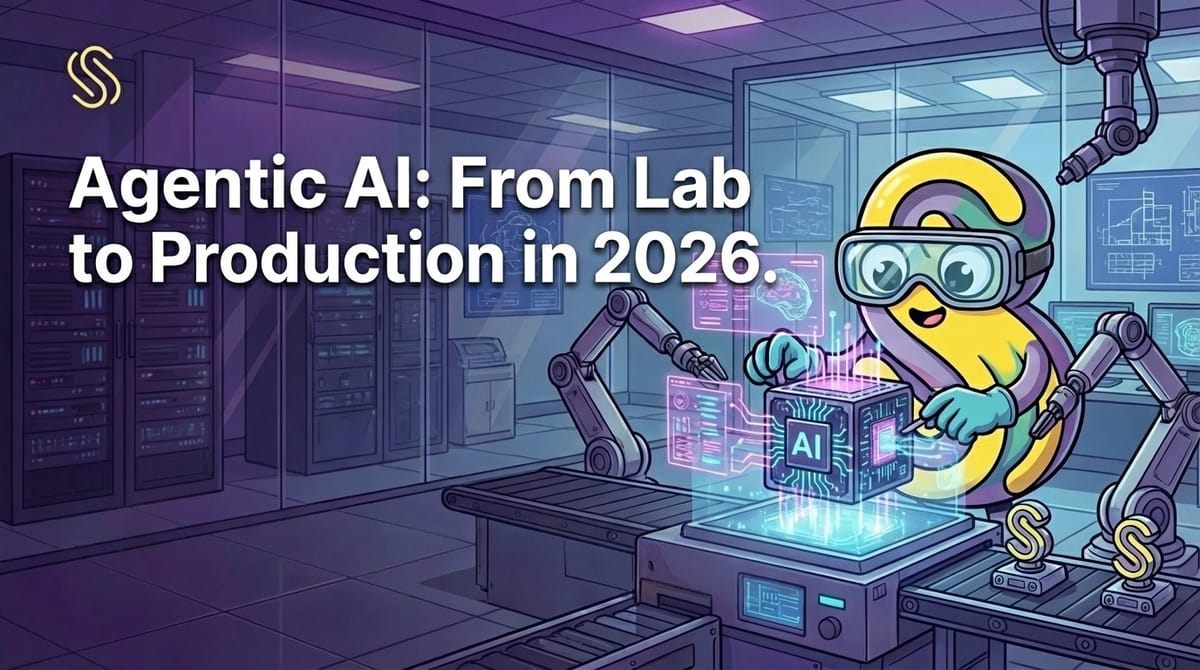
From Experimental Prototypes to Production-Ready Systems
Agentic AI has experienced a transformative journey from its early experimental stages to robust, production-grade infrastructure by 2026. The initial wave of agent-based systems in the early 2020s focused on isolated proof-of-concept deployments—single-purpose bots or narrowly scoped assistants that demonstrated potential but lacked resilience, memory, and scalability. Key milestones included the emergence of open-source reasoning models like DeepSeek-R1 and IBM’s Granite series, which enabled more sophisticated planning and tool usage.
By mid-decade, breakthroughs such as modular architectures and advanced memory management allowed agents not only to react but also to plan across steps with context awareness. This evolution shifted design philosophies toward systems over standalone models, emphasizing orchestration layers capable of coordinating multiple specialized agents—heralding an era where enterprise value is delivered through dynamic teams of collaborating AI entities rather than monolithic solutions.
Understanding Multi-Agent Orchestration Frameworks
At the core of this evolution lies multi-agent orchestration—a paradigm that enables intelligent coordination among autonomous agents working towards shared goals. Leading frameworks like LangChain, CrewAI, and Microsoft AutoGen have redefined how developers build scalable agentic applications:
- LangChain: Known for its LangGraph module supporting complex stateful workflows, LangChain facilitates integration with over 100 LLM providers while offering extensive tools for memory management.
- CrewAI: Pioneers role-based collaboration where each agent is assigned a specific function (such as researcher or analyst), enabling seamless delegation within a “crew” structure akin to human teams.
- Microsoft AutoGen: Focuses on enterprise reliability with built-in support for conversable agents who can collaborate via natural language while integrating human-in-the-loop oversight crucial for compliance-heavy industries.
These frameworks manage everything from workflow decomposition to error handling—ensuring continuous adaptation as tasks evolve—all underpinned by flexible plugin architectures that allow rapid extension into new domains.
Scalability and Integration in Production Environments
The leap from prototype to production hinges on orchestrating large-scale workflows without compromising speed or accuracy. For instance, global logistics firms now deploy CrewAI-powered multi-agent systems capable of handling real-time dispatch optimization across thousands of routes daily. Similarly, manufacturers leverage Microsoft AutoGen’s orchestration layer for predictive maintenance—where swarms of domain-specific agents analyze sensor data streams collaboratively before triggering interventions autonomously.
Such deployments demonstrate how modern frameworks provide durable infrastructure (with failover mechanisms) alongside rich API integrations; this ensures agents can access databases, knowledge graphs, and operational tools required for mission-critical decision-making at scale.
Key Technical Challenges and Solutions
Despite these advances, challenges persist—including ensuring consistent agent coordination amidst growing complexity; minimizing latency during inter-agent communication; and robustly managing errors in unpredictable environments. By 2026:
- Modular system designs isolate failures,
- Flexible reasoning modes let agents adapt strategies dynamically,
- Advanced observability features enable real-time monitoring,
—all collectively making today’s Agentic AI both reliable enough for high-stakes industry use cases yet adaptive enough to accommodate future innovation globally.
Governance and Security Frameworks in Agentic AI Systems
Agentic AI’s migration from experimental labs to global enterprise production has introduced urgent new challenges around governance, security, and human oversight. As organizations scale multi-agent orchestration frameworks into sensitive domains—finance, healthcare, logistics—the need for robust policy controls and zero-trust architectures becomes paramount. Below, we break down the core components of secure agentic operations: governance models that address compliance risks; technical safeguards against emerging attack vectors; structured human-in-the-loop (HITL) integration; and real-world examples demonstrating measurable impact.
Overview of Agent Governance and Compliance Challenges
Deploying autonomous agents at scale exposes enterprises to a spectrum of regulatory and operational risks:
- Fairness: Bias amplification is a persistent threat if agent decisions are not routinely audited.
- Safety & Reliability: Unchecked autonomy may lead to unpredictable outputs or cascading failures—as seen in notable cases where insufficient oversight resulted in financial losses or reputational harm.
- Compliance Trends: Regulatory momentum is accelerating worldwide. The EU AI Act mandates demonstrable human oversight (Article 14), while standards like NIST AI RMF emphasize continuous risk management across the full lifecycle.
To ensure trust in agent-driven outcomes, modern governance must embed transparency, accountability, privacy protection—and support cross-jurisdictional regulations such as GDPR or HIPAA.
Technical Controls and Security Frameworks
Securing large-scale agent systems requires multilayered defense strategies built on identity-first principles:
- Layered Defense & Policy Engines
- Centralized IAM integrates non-human identities with enterprise policies.
- Zero Trust design ensures no implicit trust between agents—every interaction demands verification.
- Continuous Testing & CI/CD Security Gates
- Automated pipelines enforce code scanning and vulnerability checks before deployment.
- Risk mitigation workflows trigger anomaly detection alerts during runtime.
- Governance Guardrails
- Role-Based Access Control (RBAC) restricts tool usage per agent role.
- Short-lived credentials minimize exposure windows for privileged actions.
| Layer | Core Safeguard | Example Standard |
|---|---|---|
| Perception | Input validation/authentication | OWASP LLM01/02 |
| Planning | RBAC/ABAC constraints | SOC 2 / ISO/IEC 42001 |
| Action | Audited API calls | FedRAMP / PCI DSS |
| Memory | Data encryption; retention limits | GDPR |
Comprehensive observability tools log all actions for auditability—a requirement increasingly codified by evolving international standards.
Human-in-the-Loop Integration for Safe Autonomy
Human oversight remains essential for both ethical alignment and operational safety within autonomous workflows:
- Escalation Protocols: In high-stakes scenarios (e.g., medical diagnoses or credit approvals), HITL checkpoints allow humans to intervene when anomalies arise or confidence thresholds are unmet.
- Framework Models: Patterns such as “human-on-the-loop” (real-time supervision) versus “human-behind-the-loop” (post-hoc audit/review) enable tailored escalation based on use-case criticality.
Practical examples include financial trading bots requiring manual sign-off above risk thresholds or customer service AIs escalating ambiguous queries directly to expert staff—ensuring accountability without stifling innovation velocity.
Case Studies: Governance Frameworks in Action
Global leaders now demonstrate tangible ROI from mature governance practices:
— A multinational bank implemented end-to-end audit trails using centralized IAM across its loan approval agents, achieving near-zero compliance violations post-deployment.
— An insurance provider integrated HITL checkpoints into claim assessment flows via CrewAI orchestration; this reduced erroneous payouts by over 30% while maintaining rapid response times.
These results underscore how rigorous security frameworks paired with transparent governance empower enterprises to harness Agentic AI safely amid mounting regulatory scrutiny worldwide.
Cost Optimization Strategies for Agentic AI: FinOps in 2026
The Rise of FinOps for Agentic AI Systems
As Agentic AI matures into a core enterprise capability, financial operations (FinOps) have become indispensable to managing the complex and rapidly growing costs associated with multi-agent systems. Unlike traditional IT workloads, Agentic AI deployments often involve dynamic scaling across cloud platforms, unpredictable resource consumption due to real-time orchestration, and specialized hardware (like GPUs or TPUs) that can drive up expenses swiftly. In 2026, leading organizations recognize that effective cost control requires discipline beyond legacy budgeting—embracing FinOps not just as a reporting function but as an operational strategy tightly coupled with business outcomes.
Key Cost Optimization Techniques
Modern enterprises deploy several actionable strategies to optimize costs within production-ready agent-based architectures:
- Resource Rightsizing: Multi-agent systems leverage autonomous agents to continuously monitor CPU/GPU/memory usage and automatically downscale overprovisioned resources. For instance, Revefi’s RADEN platform enabled one client to auto-pause idle Snowflake warehouses post-ETL jobs—achieving up to 70% reduction in idle compute spend.
- Reserved Instances & Commitment Management: Predictive analytics inform decisions on purchasing reserved instances versus on-demand capacity. Advanced tools benchmark performance-per-dollar—not simply sticker price—to select optimal configurations; benchmarking may reveal CPUs outperforming GPUs for specific inference tasks at half the cost.
- Intelligent Automation & Anomaly Detection: Platforms like nOps integrate anomaly detection and automated cleanup routines (e.g., terminating zombie containers), surfacing inefficiencies before they spiral into large overruns.
- Unified Reporting & Spend Visibility: Adopting standards such as FOCUS (FinOps Open Cost and Usage Specification) ensures unified data across providers; this enables transparent allocation even in fragmented multi-cloud environments.
These innovations empower cross-functional teams—from engineering through finance—to act on real-time insights rather than reactive reviews.
Measuring ROI and Business Impact
The value of FinOps is increasingly measured by its ability to translate technical efficiency into tangible business results. Organizations deploying agent-native cost controls report quantifiable savings—a Cribl case study saw 50–60% lower cloud data warehouse bills after implementing always-on optimization agents via RADEN. Moreover, streamlined workflow automation accelerates time-to-value while reducing manual oversight by over 90%, directly supporting both bottom-line savings and greater agility in innovation cycles.
Challenges and Emerging Trends in AI Cost Governance
Despite these advances, challenges persist around scaling agent fleets efficiently amid evolving pricing models—including spot market volatility or opaque SaaS billing structures. Looking ahead, expect further integration of self-correcting agents capable of proactive policy enforcement—and increasing reliance on predictive forecasting—as organizations seek sustainable growth without budgetary surprises worldwide.
Emerging Agent-Native Business Models and Market Impact
Defining the Agent-Native Enterprise
The agent-native enterprise represents a transformative departure from traditional, data-centric business models. Rather than relying on static data movement or basic automation, these organizations embed autonomous AI agents at their operational core. This shift enables enterprises to transition from siloed database workflows towards dynamic knowledge graphs—where information is indexed contextually and agents orchestrate end-to-end processes autonomously. The result is an “outcome-as-a-service” paradigm: value realization is measured not by software usage but by verifiable impact, enabling rapid adaptation and greater capital efficiency. For business and technical leaders alike, embracing agent-native structures means unlocking compounding intelligence loops that drive superior agility, scalability, and competitive differentiation in global markets.
Case Examples of Agent-Native Startups
Agentic AI has enabled startups worldwide to disrupt established sectors with measurable success:
- Logistics: Companies like Flexport have implemented multi-agent orchestration for real-time freight optimization—delivering up to 30% reductions in transit time through autonomous rerouting.
- Finance: Fintech innovators such as Ramp harness agent frameworks for continuous spend analysis and anomaly detection; recent deployments show up to 70% cut in manual expense review cycles while maintaining compliance.
- Enterprise Automation: Startups including Arcade.dev empower hundreds of clients with secure multi-agent systems managing everything from CRM integrations to workflow execution—with reported average ROIs exceeding 170%, according to industry surveys.
These pioneers demonstrate how agentic architectures confer both operational resilience (through automated error handling) and substantial cost savings across industries.
Market Trends and Ecosystem Restructuring
Ecosystem dynamics are rapidly shifting as tiered service providers, platform vendors, and standards bodies adapt for widespread agent adoption:
- Tiered Services: Specialized platforms now offer modular orchestration layers supporting interoperability between vendor tools—a response to increasing demand for cross-domain workflows.
- Platform Adaptation: Cloud providers integrate native authorization runtimes (e.g., MCPs), standardizing security controls at scale.
- Emerging Standards: Industry alliances work toward unified protocols ensuring safe delegation of agency functions—the foundation for trusted enterprise deployment.
For software developers and enterprises alike, this restructuring accelerates agile development lifecycles while lowering integration risk globally.
Future Outlook: Business Value and Innovation Drivers
Looking ahead to 2026—and beyond—agent-native models are set to become foundational drivers of AI-powered economies. Organizations will see innovation opportunities around proprietary data moats, ultra-fast onboarding via automated agents (<48 hours TTFV), and embedded regulatory compliance engines. As jurisdictions tighten oversight on autonomy risks, adaptive governance frameworks will differentiate market leaders poised for sustainable growth amid accelerating digital transformation worldwide.
7 Agentic AI Trends to Watch in 2026 — MachineLearningMastery Agentic AI Strategy — Deloitte Insights / AI and Enterprise Tech Predictions for 2026 — SolutionsReview / Agentic AI Architecture: A Practical, Production-Ready Guide — Medium / FinOps in the Age of AI — Finout Blog