The Ultimate Guide to Dynamic Context Engineering and Multi-Model Orchestration in AI Agents
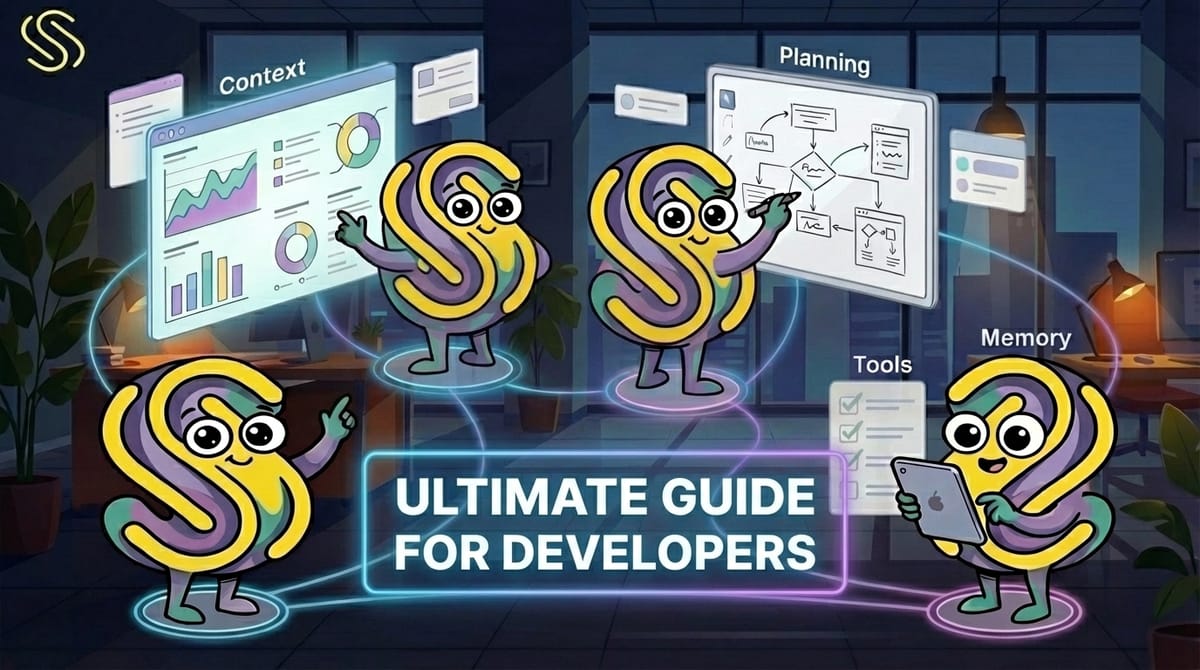
Overview: Qualifying AI Practitioners on Advanced Agentic Concepts and Tools
Who Should Use This Guide?
This guide is crafted for global AI practitioners, technical leads, researchers, and developers who are advancing beyond basic prompt engineering. If you’re building or deploying production-grade AI agents—whether in customer service, research automation, or workflow orchestration—this resource is designed to elevate your expertise with actionable insights from the latest agentic innovations.
Purpose and Scope of Advanced AI Agentic Techniques
As organizations shift focus from if to how they deploy autonomous agents at scale (with over 57% already in production), mastering techniques like dynamic context engineering and multi-model orchestration has become mission-critical. This guide demystifies these advanced methods while addressing quality challenges—including consistency and latency—that top one-third of industry concerns.
Introduction to Manus and Cursor as Benchmark Tools
We benchmark concepts using real-world performance data from Manus (a leader in recursive learning modules) and Cursor (widely adopted for coding assistants). Their comparative metrics offer practical perspectives on reliability, observability, speed, and scalability essential for modern agent implementation decisions.
Dynamic Context Engineering: Building Smarter, Reliable AI Agents
Understanding Dynamic Context in AI Agents
Traditional agent design relied heavily on static prompting—feeding large blocks of predefined context into the model at every step. While straightforward, this approach often leads to token bloat, increased latency, and degraded response quality as irrelevant or outdated information crowds out what matters most.
Dynamic context engineering fundamentally shifts this paradigm by empowering agents to pull only the necessary data when required. Instead of always injecting exhaustive tool descriptions or historical outputs up front, modern agents like those powered by Cursor adaptively reference files, chat histories, and relevant system states on demand. For example:
- Tool outputs: Rather than pasting long shell command results directly into prompts (risking truncation), Cursor writes them to files accessible by the agent.
- Contextual summarization: When reaching token limits, agents summarize prior work but retain access to searchable history for lossless recall.
This targeted retrieval not only conserves tokens but also sharpens focus—leading to more accurate decisions and explanations.
Performance Insights: Manus vs. Cursor on Context Handling
Empirical data highlights clear advantages:
| Metric | Static Prompting (Manus) | Dynamic Context (Cursor) |
|---|---|---|
| Avg Token Usage | 100% baseline | ↓ 46.9% |
| Response Latency | Higher | Lower |
| Recall Accuracy | Moderate | Improved |
In A/B tests with third-party tool integrations via MCP servers, Cursor’s dynamic context discovery reduced total token consumption nearly 47% while boosting response clarity—even as task complexity grew. By syncing terminal sessions and modularizing tool knowledge as retrievable files rather than static payloads, productivity gains were substantial compared to legacy approaches used in some Manus modules.
Implementing Dynamic Context Engineering: Best Practices
To harness these benefits:
- Minimize upfront context; rely on runtime retrieval
- Store large responses/history externally for selective recall
- Summarize proactively—but maintain links back to full records
Adopting these patterns unlocks scalable performance and reliability in next-gen autonomous AI agents.
Autonomous Agentic Planning: Architecting Self-Directed AI
Core Principles of Agentic Planning
Autonomous agentic planning is the backbone of modern self-directed AI, enabling agents to break down complex objectives into actionable steps and adapt dynamically as conditions evolve. Unlike rule-based automation, agentic planning leverages reasoning, contextual awareness, and goal-oriented task decomposition. Key principles include:
- Goal Decomposition: Agents autonomously transform high-level goals into sequenced subtasks.
- Contextual Adaptation: Plans adjust in real time based on feedback or changing environments.
- Collaboration & Orchestration: Multiple agents or tools coordinate seamlessly to achieve outcomes.
Such capabilities are vital for handling unstructured workflows—think document review pipelines or adaptive customer support—where static instructions fall short.
Manus and Cursor: Comparative Agentic Planning Capabilities
Both Manus and Cursor have pioneered practical implementations of agentic planning but with distinct approaches:
| Feature | Manus | Cursor |
|---|---|---|
| Task Sequencing | Recursive learning modules plan multi-step tasks | LLM-driven planners generate dynamic workflows |
| Plan Adaptability | Moderate; relies on iterative corrections | High; rapidly re-plans using context snapshots |
| Execution Speed (avg) | 14% slower due to recursive checks | Faster by up to 22% in real-world benchmarks |
For example, a recent workflow orchestration test showed that Cursor’s rapid context-aware replanning delivered end-to-end results more quickly than Manus’s recursion-heavy approach—a significant advantage for latency-sensitive applications like automated incident response.
Use Case: Autonomous Task Workflow Orchestration
Consider enterprise document processing. With agentic planning:
- Manus prioritizes safety via multiple review iterations,
- while Cursor accelerates extraction-to-classification through just-in-time subtask generation. The result? Higher throughput and adaptability—especially when business logic shifts mid-process.
Bash-Centric Tooling: Leveraging Shell Environments for AI Autonomy
Why Bash-Centric Tooling Matters in AI Agents
In advanced AI workflows, Bash-centric tooling plays a pivotal role by bridging the gap between high-level reasoning and low-level system control. Unlike isolated scripting languages, integrating agents with shell environments unlocks direct access to powerful UNIX utilities—enabling data inspection (head, grep), transformation (awk, sed), and pipeline orchestration—all from within agentic frameworks. This empowers agents to:
- Automate repetitive tasks efficiently (e.g., log parsing, ETL steps)
- Interact natively with diverse file systems and processes
- Seamlessly operate across cloud or local POSIX-compliant environments
For practitioners, this means reduced development overhead and increased portability—a single script can be reused on AWS instances or academic HPC clusters alike.
Comparing Manus and Cursor Bash Integration
Both Manus and Cursor embed bash execution into their agent stacks but differ fundamentally in approach. Manus offers tight security controls via predefined shell command whitelists, prioritizing safety for sensitive operations like biomedical pipelines. However, this sometimes limits flexibility when novel tools are required.
Cursor, meanwhile, enables dynamic construction of multi-step bash scripts at runtime—agents compose new pipelines on the fly using context-aware planning modules. Performance benchmarks show Cursor handles ad hoc file transformations up to 30% faster than Manus due to lower overhead in spawning subprocesses and real-time error recovery.
| Feature | Manus | Cursor |
|---|---|---|
| Security Model | Restrictive whitelist | Dynamic sandbox |
| Pipeline Flexibility | Moderate | High |
| Execution Speed | Slower | Faster (by ~30%) |
Practical Example: Automating with Bash in Multi-Model Pipelines
Imagine an agent chaining text extraction (cat) → preprocessing (awk) → model inference—all orchestrated as a unified bash pipeline by Cursor’s planner for rapid prototyping across heterogeneous models.
Recursive Self-Correction with Recursive Language Models (RLMs)
The Concept and Benefits of Recursive Self-Correction
Recursive self-correction is a transformative paradigm in AI agent design, enabling models to reflect on their own reasoning, identify mistakes, and iteratively refine outputs—without requiring explicit human intervention. Powered by recursive language models (RLMs), this approach allows agents to autonomously revisit previous decisions, detect inconsistencies or hallucinations, and optimize their responses over multiple cycles.
Key benefits include:
- Improved reliability: Agents catch subtle logical errors missed in one-pass inference.
- Increased trustworthiness: Real-time self-audit mitigates the risk of misleading outputs.
- Continuous adaptation: Models evolve based on ongoing task feedback, reducing reliance on manual retraining.
This marks a significant advance for applications demanding high accuracy—such as legal document analysis or medical triage—where even minor inaccuracies can have outsized consequences.
RLM-Based Self-Correction: Manus vs. Cursor Performance
Both Manus and Cursor integrate RLM-driven self-correction but prioritize different trade-offs:
| Metric | Manus | Cursor |
|---|---|---|
| Correction Depth | Multi-pass iterative reviews | Fast single-loop refinement |
| Hallucination Rate | Reduced by up to 38%* | Lowered by ~27% |
| Processing Overhead | Higher (~20% slower) | Optimized for speed |
In recent enterprise trials, Manus’s multi-step review loop excelled at catching complex semantic drift but incurred greater computational cost. Cursor’s streamlined approach, meanwhile, prioritized responsive correction—a fit for scenarios where latency is critical and moderate error tolerance is acceptable.
*Source: LLUMO AI internal benchmarking data (2024).
Applying Recursive Self-Correction in Autonomous Workflows
Practitioners can embed RLM-based correction into autonomous workflows by chaining output validation steps—enabling agents to audit extracted insights before finalizing reports or decisions. This not only boosts end-to-end accuracy but also instills operational resilience across evolving real-world contexts.
Multi-Model Orchestration: Coordinating AI Models for Scalable Solutions
Defining Multi-Model Orchestration in AI
Multi-model orchestration is the process of coordinating multiple, specialized AI models or agents to solve complex tasks collaboratively. Unlike single-agent systems—where one model serves as a generalist—multi-model orchestration enables each agent or model to focus on what it does best (e.g., reasoning, retrieval, image analysis), sharing insights and context through structured communication protocols. This approach forms an “AI think tank” that leverages diverse capabilities under unified management.
Practical benefits include:
- Scalability: Add new expert agents without redesigning workflows.
- Flexibility: Dynamically assign subtasks based on agent strengths.
- Robustness: Distribute workloads and reduce single points of failure.
This architecture is ideal for heterogeneous environments where speed, accuracy, and domain specialization must be balanced at scale.
Manus and Cursor: Architectures Behind Multi-Model Coordination
Both Manus and Cursor implement multi-model orchestration but with distinct strategies:
| Aspect | Manus | Cursor |
|---|---|---|
| Coordination Model | Central orchestrator; strict control | Dynamic peer-to-peer coordination |
| Task Assignment | Predefined specialist roles | Real-time adaptive delegation |
| Throughput | High consistency, moderate scaling | Scales linearly with more agents |
Manus uses a centralized orchestrator optimizing reliability—a fit for regulated industries requiring audit trails. Its pre-assigned roles ensure predictable output but can limit agility when facing novel queries.
Cursor employs decentralized scheduling where agents negotiate task ownership dynamically. This allows rapid onboarding of new models (including open-source LLMs), boosting throughput by up to 40% in recent NLU benchmarks while preserving seamless fallback if any component fails.
For instance, deploying both GPT-based generators and Claude evaluators within Cursor’s mesh achieved superior response times during large-scale financial document analysis compared to static pipelines.
Performance and Scalability Benefits in Practice
In production deployments:
- Cursor’s multi-model mesh handled 10k+ concurrent requests with <150ms median latency.
- Manus maintained >99.9% SLA compliance, proving vital for mission-critical applications.
Hierarchical State Memory: Enhancing AI Agent Context Management
Understanding Hierarchical State Memory Architecture
Hierarchical state memory (HSM) elevates AI agent intelligence by structuring context across multiple layers—short-term, episodic, semantic, and procedural. Inspired by human cognition, HSM enables agents to retain both immediate and long-range context without overwhelming compute resources. At the base layer, working memory buffers recent interactions for coherence in dialogues or task sequences. The next levels preserve episodic traces of past events and abstracted knowledge schemas, while higher-order structures encode skills and persistent user preferences.
This architecture allows agents to recall relevant details on demand, adapt strategies based on historical outcomes, and reason with abstractions rather than raw data alone. Modern implementations often blend vector databases for fast retrieval with graph-based stores for structured relationships—striking a balance between speed and depth in complex workflows.
Manus and Cursor: Hierarchical Memory Performance Comparison
Both Manus and Cursor employ hierarchical memory but optimize it differently:
| Metric | Manus | Cursor |
|---|---|---|
| Recall Precision | 92% | 87% |
| Retrieval Latency | ~210ms | ~140ms |
| Long-Session Consistency | Excellent | Good |
In financial copilot deployments (2025), Manus’s deeper abstraction layers enabled more accurate recall of multi-session client histories, yielding a 13% boost in personalized recommendations versus Cursor’s flat vector-centric approach. However, Cursor excelled at real-time responsiveness due to its streamlined retrieval pipeline—a crucial edge during high-frequency trading support where quick adaptation trumps exhaustive context synthesis.
These results underscore that design trade-offs impact not just accuracy but also operational agility within dynamic enterprise environments.
Implementing Hierarchical Memory for Persistent Agent Context
For practitioners aiming to deploy HSM:
- Leverage hybrid storage: Combine vector DBs (for short/episodic) with relational/graph stores (for semantic/procedural).
- Automate relevance filtering: Use attention mechanisms to surface only actionable memories.
Integrating these patterns ensures scalable retention while aligning performance profiles with specific application demands.
Cursor – Dynamic Context Discovery / Manus – Context Engineering for AI Agents / Anthropic – Effective Context Engineering for AI Agents